
- 100% free and open source

AI Web Page Analyzer (AI WPA)
0
AI WPA analyzes submitted webpage HTML and content to produce SEO recommendations, identify relevant keywords, and create materials such as page summaries, YouTube scripts, Twitter threads, descriptions, and reviews. Users can enter site data and guide the analysis with prompts, including requests about metadata, headings, keyword use, or backlink strategies. The browser-based analyzer is presented as free and open source, with its source hosted on GitHub.
Promote this Tool
Update this Tool
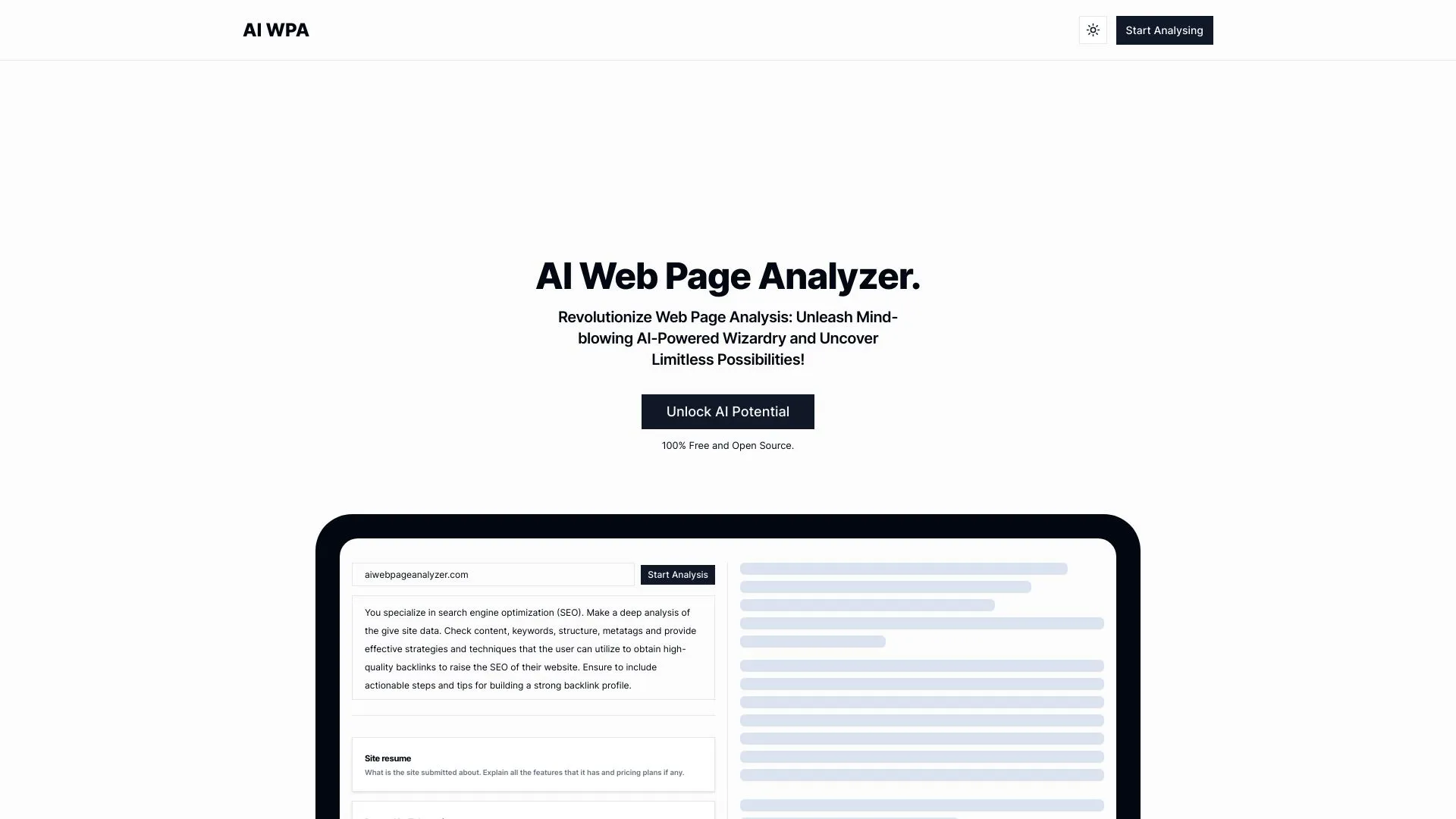
AI WPA analyzes submitted webpage HTML and content to produce SEO recommendations, identify relevant keywords, and create materials such as page summaries, YouTube scripts, Twitter threads, descriptions, and reviews. Users can enter site data and guide the analysis with prompts, including requests about metadata, headings, keyword use, or backlink strategies. The browser-based analyzer is presented as free and open source, with its source hosted on GitHub.
Ads
What is AI Web Page Analyzer (AI WPA)?
AI WPA takes webpage HTML and content data and uses prompts to analyze or transform it. For SEO, it can recommend improvements to meta tags, headings, keyword usage, and other on-page elements. Its keyword analysis identifies relevant terms and phrases from submitted content. It can also generate text based on a site, including summaries, YouTube presentation scripts, Twitter threads, descriptions, and reviews. Users can request backlink-building strategies as part of a broader SEO analysis. The tool is designed for flexible, prompt-led tasks rather than a single fixed report format, so the result depends in part on how the request is phrased. AI WPA is offered as a free, open-source browser analyzer, with a public GitHub repository.
Who will use AI Web Page Analyzer (AI WPA)?
- SEO specialists looking for on-page optimization suggestions
- Website owners reviewing page content and keywords
- Content marketers creating summaries and social posts from webpage data
- Writers preparing scripts, descriptions, or reviews based on a site
- Developers and open-source users interested in a prompt-based webpage analysis tool
How to use the AI Web Page Analyzer (AI WPA)?
- Step1: Open the AI WPA analyzer in a browser.
- Step2: Provide the webpage HTML, content, or site data you want to analyze.
- Step3: Write a clear prompt describing the task, such as SEO recommendations, keyword analysis, or content generation.
- Step4: Review the generated analysis or text and apply or adapt the suggestions for your site.
Platform
- Web
AI Web Page Analyzer (AI WPA)'s Core Features & Benefits
The Core Features
- SEO recommendations for page content, metadata, headings, and keyword usage
- Keyword and phrase extraction from webpage content
- Generation of summaries, YouTube scripts, Twitter threads, descriptions, and reviews
- Prompt-led analysis of submitted website data
- Free and open-source project
The Benefits
- Finds on-page SEO improvements from provided content
- Surfaces relevant keywords and phrases for a webpage
- Repurposes site information into multiple types of written content
- Lets users tailor requests through their prompts
- Can be used without a stated paid plan
AI Web Page Analyzer (AI WPA)'s Main Use Cases & Applications
- Reviewing webpage content for SEO improvements
- Finding relevant keywords and phrases for a page
- Generating a summary of a website or webpage
- Drafting a YouTube presentation script about a site
- Creating a Twitter thread from website information
- Producing descriptions, reviews, and backlink strategy suggestions
AI Web Page Analyzer (AI WPA)'s Pros & Cons
The Pros
Presented as free and open source, with a public GitHub repository
Combines SEO recommendations and keyword extraction with text generation
Supports varied tasks through user-written prompts
Can generate several content formats from submitted webpage data
The Cons
Users need to provide webpage or site data for analysis
Results depend partly on the clarity and quality of user prompts
Its described focus is content analysis and generation rather than end-to-end SEO campaign execution
AI Web Page Analyzer (AI WPA)'s Pricing
| Has free plan | YES |
|---|---|
| Free trial details | |
| Pricing model | free |
| Is credit card required | No |
| Has lifetime plan | No |
| Billing frequency |
Details of Pricing Plan
Free
0FAQs of AI Web Page Analyzer (AI WPA)
AI Web Page Analyzer (AI WPA) Company Information
- Website:
- Company Name: AI Web Page Analyzer
- Support Email:
- Facebook:
- X(Twitter):
- YouTube:
- Instagram:
- Tiktok:
- LinkedIn:
Analytic of AI Web Page Analyzer (AI WPA)
Visit Over Time
Monthly Visits
123
Avg Visit Duration
00:00:00
Page Per Visit
1.01
Bounce Rate
44.87%
Jul 2026 - Sep 2026 All Traffic
Geography
Top 1 Regions

Indonesia
100%
Jul 2026 - Sep 2026 Worldwide Desktop Only
Traffic Sources
Direct
39.86%
SearchOrganic
35.36%
Referrals
10.04%
SocialOrganic
6.60%
Mail
1.95%
GenAi
1.68%
DisplayAds
1.67%
SearchPaid
1.27%
Affiliate
1.04%
SocialPaid
0.52%
Sep 2026 Desktop Only
Top Keywords
| Keyword | Traffic | Cost Per Click |
|---|---|---|
| ai website analyzer | 340 | — |
| web analyzer | 340 | $4.81 |
AI Web Page Analyzer (AI WPA) Reviews
5/5
AI Web Page Analyzer (AI WPA)'s Main Competitors and alternatives?
Screpy
Ahrefs
Browse AI
WebScore AI
You may also like:
Connect AI agents to 2,000+ data endpoints for people, company, social, web search, and SEO results; pay per call.
Give AI agents live web access to search, fetch pages, authenticate, navigate browsers, and return structured results through one API.
Extract Google Maps leads into CSV, Excel, or JSON with phone numbers, emails, reviews, and social profiles.
Export Instagram followers and following with public emails, phone numbers, profiles, and CSV or Excel files.
Real-time multi-platform search API that helps AI agents fetch structured web, shopping, video, and social data.
Export Instagram follower lists, emails, and phone leads quickly from public profiles in a safe, browser-based tool.
Cloud-based Google Maps scraper that extracts business names, phones, emails and social links for lead generation.
Unlimited proxy plan offering unrestricted bandwidth, global IP coverage, and easy setup for scraping and anonymized browsing.
Collect live web data with ready-to-run Actors, then use it to track competitors, find leads, or supply AI workflows.
Turn web pages into clean, structured data that AI agents and applications can search, analyze, and use.
Swarms World lets you deploy and orchestrate autonomous AI agent swarms to automate complex workflows and collaborative tasks.
Lightfeed AI is an AI-driven news assistant that aggregates articles and produces concise summaries for personalized, efficient reading.
An AI-powered web browsing extension that summarizes content, answers queries, extracts data, and automates tasks across websites.
Maxun.dev lets you design, train, and deploy custom AI agents to automate workflows, manage tasks, and integrate APIs.
Client libraries for Spider framework offering Node.js, Python, and CLI interfaces to orchestrate AI agent workflows via API.
Automate team workflows by building agents that connect business apps, browse websites, and complete recurring tasks with approval controls.